Page Not Found
Page not found. Your pixels are in another canvas.

A list of all the posts and pages found on the site. For you robots out there is an XML version available for digesting as well.
Page not found. Your pixels are in another canvas.
Ph.D. student in Computer Science at The Ohio State University working on generative modeling and representation learning.
Photos from conferences, travel, and life outside the lab.
High-Performance Computing and Big Data Analysis: Second International Congress, TopHPC 2019, 2019
This paper introduces a new method that utilizes weak supervision and deep learning to solve partial differential equations (PDEs) using only boundary and initial conditions, making it suitable for unknown PDEs without labeled data. The approach is evaluated by solving the Reaction-Diffusion equation, demonstrating high consistency with the finite difference method and highlighting the effectiveness of weakly supervised learning in solving various types of differential equations.
arXiv preprint, 2019
This paper addresses the estimation of travel times for various road segments and time intervals using GPS data and Matrix Factorization techniques. By aggregating GPS data into a matrix and applying the Alternating Least Squares (ALS) method with regularization, the proposed approach effectively solves the sparsity problem and accurately estimates travel times. Evaluation results using real data from a large online taxi dispatching system in Iran demonstrate the strength and effectiveness of the proposed method.
arXiv preprint, 2019
In this study, a deep neural network was trained to predict the solution of the reaction-diffusion equation with varying coefficients, utilizing numerical and analytical solutions. Dimensional analysis technique was employed to reduce learning time and identify similar equation solutions. The results show that deep learning successfully estimated the solution of the reaction-diffusion equation with a constant coefficient, highlighting its accuracy in solving partial differential equations.
High-Performance Computing and Big Data Analysis: Second International Congress, TopHPC 2019, 2019
This work introduces a novel software test Oracle based on deep learning and a fuzzy inference system, aimed at automating the testing process while minimizing time and cost. The Oracle maps the software output to a fuzzy space using Takagi-Sugeno-Kang fuzzy inference and trains a deep neural network. The performance of the Oracle is evaluated using different models, demonstrating its ability to accurately detect correct and false results.
The 7th International Conference on Contemporary Issues in Data Science, 2020
In This work demonstrates the effectiveness of deep learning in solving the problem of two-dimensional heat transfer in an arbitrary domain. Using the finite volume method, the researchers trained a deep neural network on 100,000 cases to predict the heat transfer solution. The results show that the network achieved satisfactory precision compared to the commercial program ANSYS, indicating the potential of deep learning in accurately predicting physics-based heat transfer phenomena.
ACM SIGSPATIAL 2022 — 30th International Conference on Advances in Geographic Information Systems, Seattle, Washington, USA, 2022
A computational approach for predicting future road construction projects by integrating and analyzing various types of spatiotemporal data. The approach utilizes a deep-neural-network-based model trained on a large dataset called “US-Constructions,” which includes 6.2 million road constructions with diverse attributes and road-network features. Experimental results demonstrate the effectiveness of the approach in accurately predicting future road constructions in several major cities in the United States.
Digital Communications and Networks (Elsevier), 2023
The challenges faced in adopting Industry 4.0, particularly in the field of smart factories and production, due to issues such as lack of high-quality and diverse data, fragmented data across different silos, and concerns regarding privacy and security. To address these challenges, the article proposes a decentralized architecture utilizing multi-party technologies, privacy-enhancing techniques, and AI approaches to create a collaborative platform and federated data space. Experimental results demonstrate the potential benefits of this approach for multi-party applications and data sharing based on the FAIR principles.
KDD 2023 — 29th ACM SIGKDD Conference on Knowledge Discovery and Data Mining, Long Beach, California, USA, 2023
The study introduces six novel physics-based machine learning models designed to accurately estimate indoor pollutant concentrations using cost-effective sensors, leveraging domain knowledge through a combination of physics concepts, Gated Recurrent Units, and Decomposition techniques, showcasing their superiority in terms of computational efficiency and accuracy over transformer-based models using real-world office data.
UrbanAI '23 — 1st ACM SIGSPATIAL International Workshop on Advances in Urban-AI, Hamburg, Germany, 2023
We propose CrashFormer, a multi-modal architecture that utilizes comprehensive (but relatively easy to obtain) inputs such as the history of accidents, weather information, map images, and demographic information. The model predicts the future risk of accidents on a reasonably acceptable cadence (i.e., every six hours) for a geographical location of 5.161 square kilometers.
KDD 2024 — 30th ACM SIGKDD Conference on Knowledge Discovery and Data Mining, Barcelona, Spain, 2024
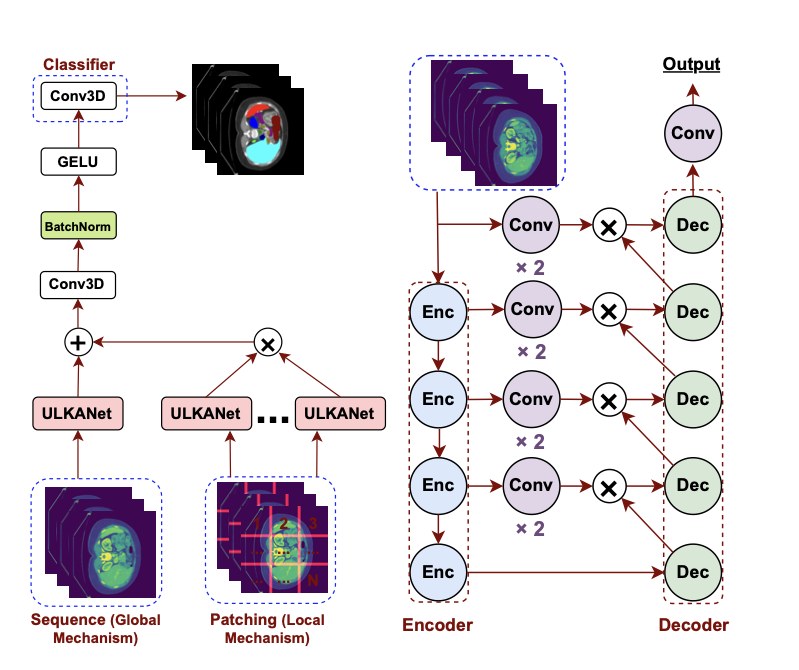
In this paper, we introduce a new neural network architecture, termed LoGoNet, with a tailored self-supervised learning (SSL) method to mitigate such challenges. LoGoNet integrates a novel feature extractor within a U-shaped architecture, leveraging Large Kernel Attention (LKA) and a dual encoding strategy to capture both long-range and short-range feature dependencies adeptly. This combination of strategies is especially beneficial in medical image segmentation, given the difficulty of learning intricate and often irregular body organ shapes. Complementarily, we propose an SSL method tailored for 3D images to compensate for the lack of large labeled datasets.
Biomedical Optics Express (Optica Publishing Group), 2024
Identifying retinal ganglion cells in 3D adaptive-optics OCT volumes normally demands extensive expert annotation. This work uses semi-supervised learning to exploit unlabeled volumes, cutting the manual labeling burden while improving identification accuracy.
ICLR 2025 — The Thirteenth International Conference on Learning Representations, Singapore, 2025
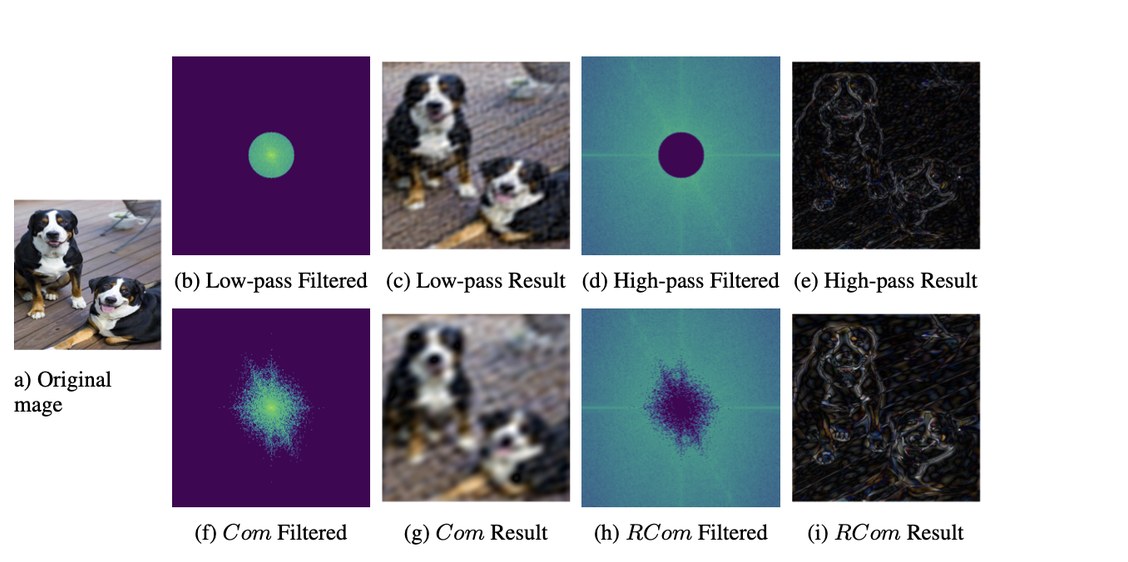
Masked image modeling usually masks patches at random, which ignores where the informative signal actually lives. This work uses the frequency content of an image to guide masking, producing a pre-training objective that learns stronger representations with markedly less pre-training data and compute.
SSI-FM Workshop, ICLR 2025, Singapore, 2025
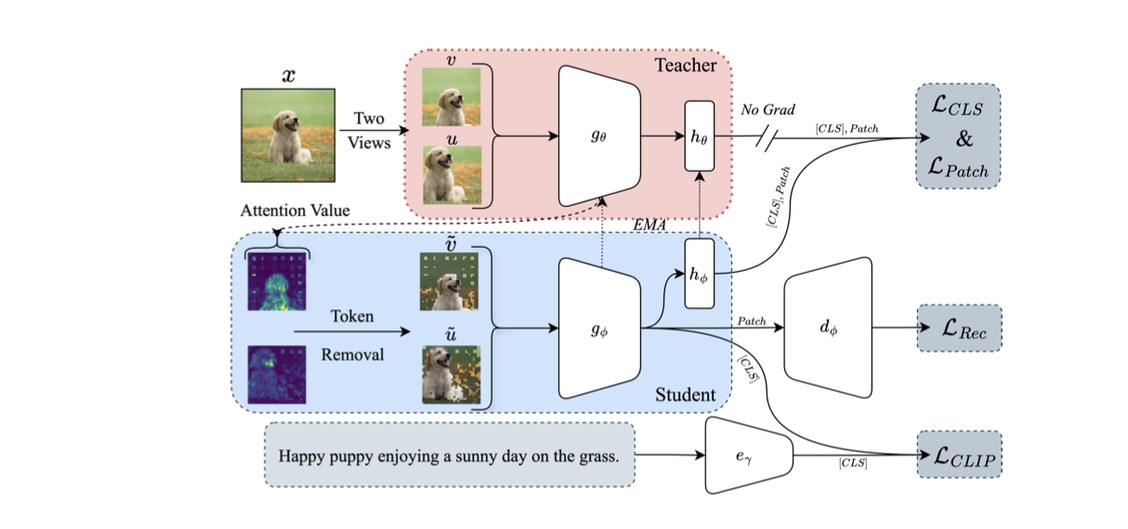
Contrastive vision-language models such as CLIP learn image-level semantics and lose the pixel-level detail that segmentation and other dense tasks depend on. DetailCLIP combines patch-level self-distillation with a reconstruction objective so that a CLIP-style encoder keeps fine spatial detail while retaining its semantic strength.
CVEU Workshop, CVPR 2025, Nashville, Tennessee, USA, 2025
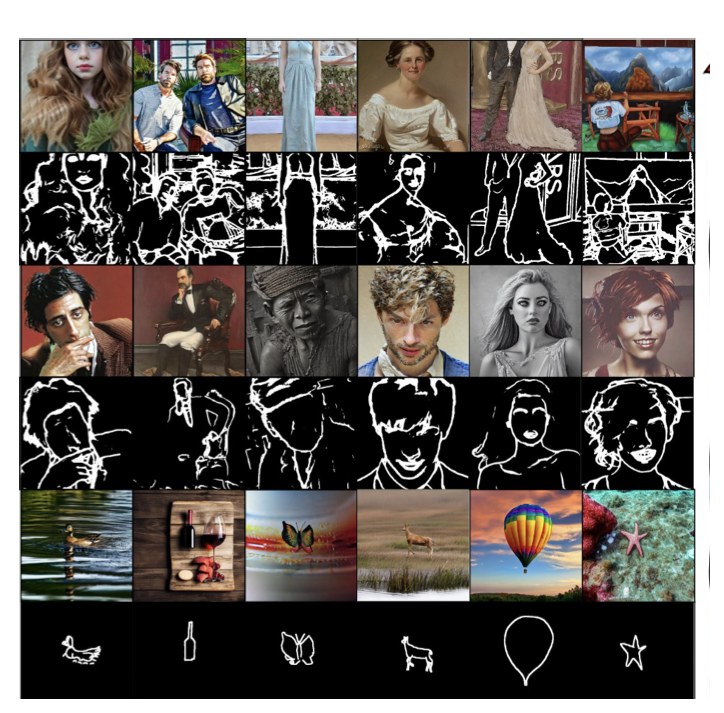
Sketch-based diffusion models tend to assume a skilled artist: they follow detailed sketches well but struggle with rough, novice drawings. KnobGen adds a single control — a “knob” — that adjusts how strictly generation follows the sketch, so the same model serves both quick doodles and precise, expert line art.
ICCV 2025 — International Conference on Computer Vision, Honolulu, Hawai'i, USA, 2025
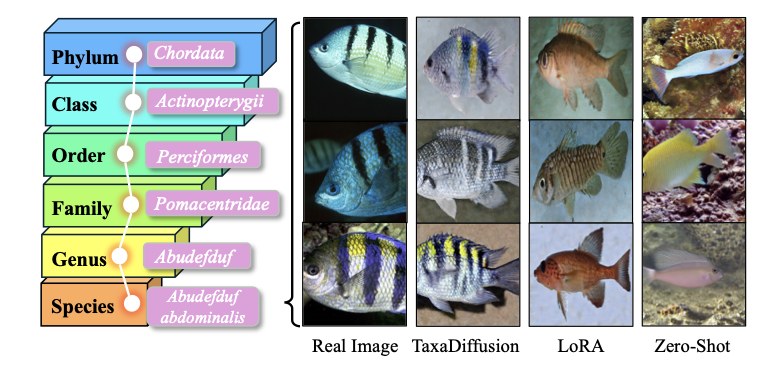
TaxaDiffusion trains a diffusion model along the biological taxonomy — from coarse ranks such as class and order down to species — so that the model first learns shared morphology and then the subtle traits that separate visually similar species. The progressive, taxonomy-aware curriculum improves fine-grained generation and makes the learned trait hierarchy inspectable.
Biomedical Optics Express (Optica Publishing Group), 2025
ISOSNet is a unified deep-learning framework that detects cone photoreceptors in adaptive-optics OCT B-scans and measures inner-segment and outer-segment lengths in a single pass, replacing a slow and subjective manual annotation workflow with an automated, reproducible one.
ICLR 2026 — The Fourteenth International Conference on Learning Representations, Rio de Janeiro, Brazil, 2026
Diffusion language models promise parallel, controllable text generation but usually need many refinement steps to match autoregressive quality. FS-DFM is a few-step discrete flow-matching model that makes the number of sampling steps an explicit parameter, so long-form text can be generated accurately with a small, fixed step budget instead of hundreds of iterations.
arXiv, 2026
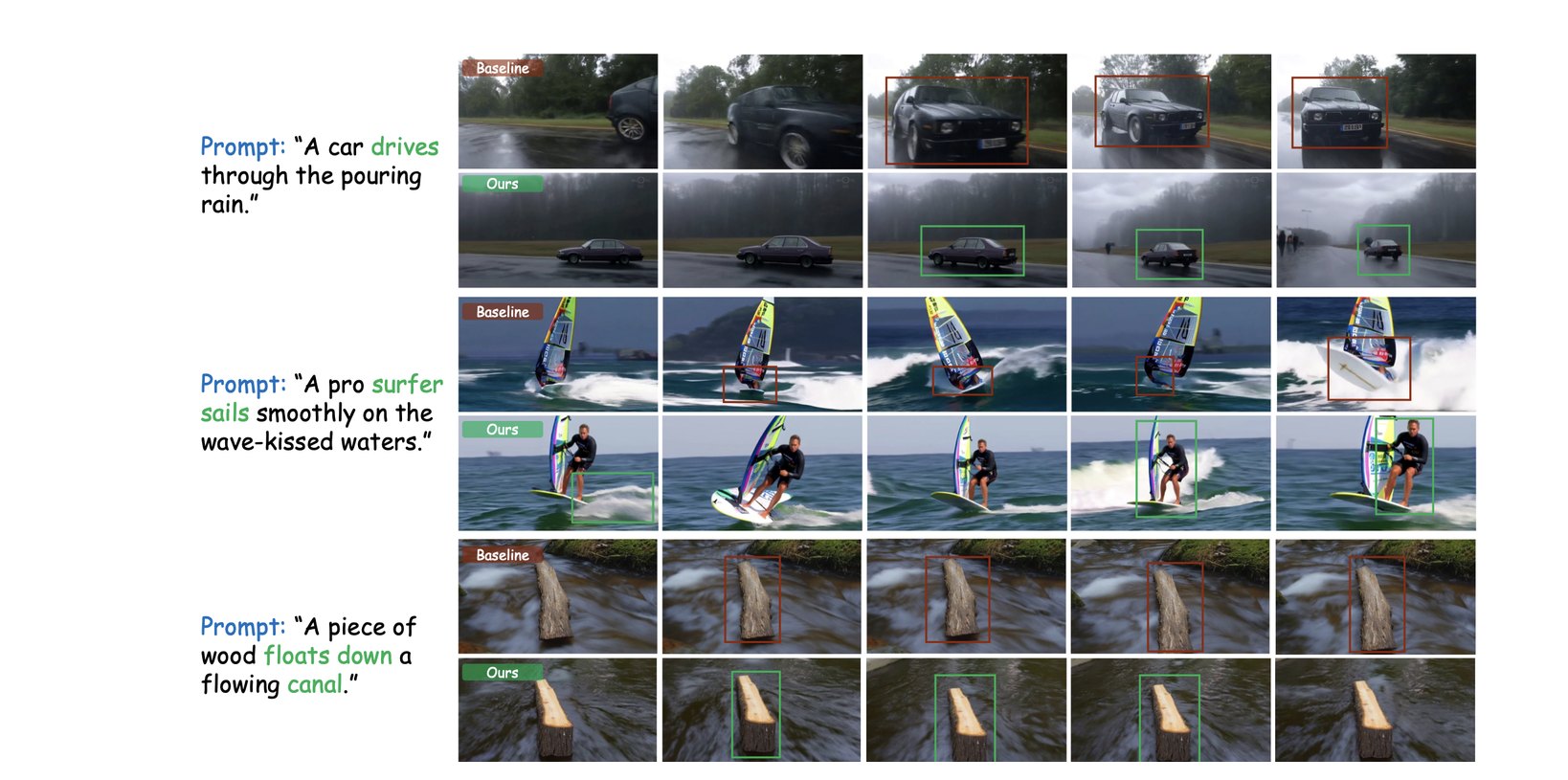
Flow-matching video generators produce temporally coherent output yet routinely violate elementary physics, because reconstruction objectives penalise per-frame deviation without distinguishing consistent dynamics from impossible ones. DiReCT identifies semantic-physics entanglement as the obstacle to contrastive flow matching in text-conditioned video, then splits the contrastive signal into a macro term that draws negatives from semantically distant regions and a micro term whose hard negatives share full scene semantics but differ along a single axis of physical behaviour.
arXiv, 2026
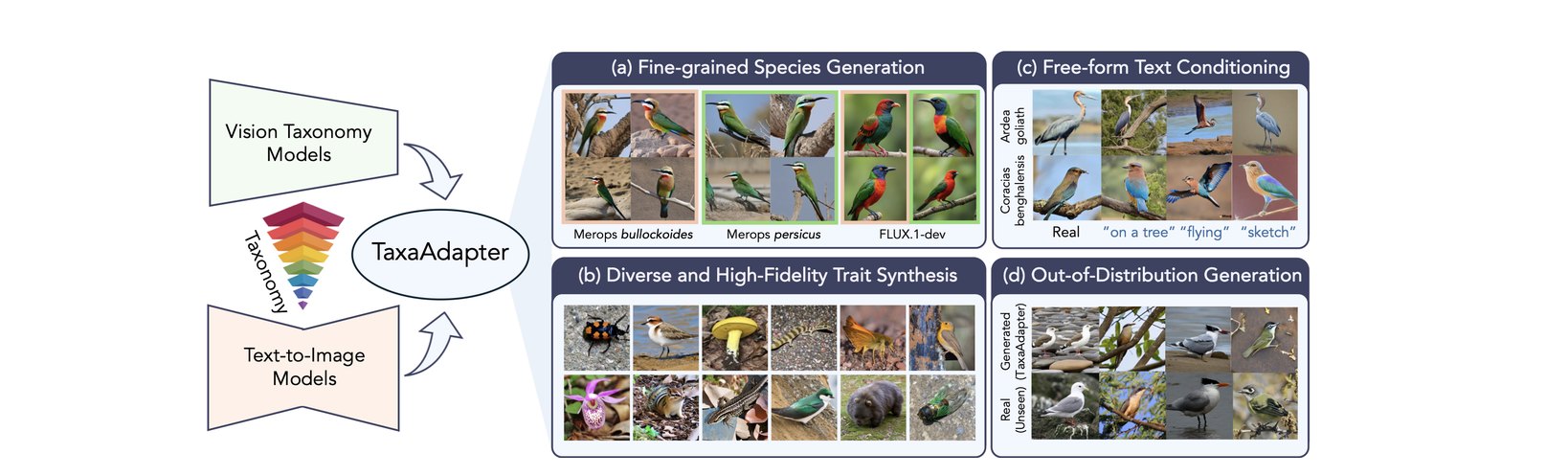
More than 10M species differ by visual traits so subtle that text-to-image models miss them even when their outputs look photo-realistic. TaxaAdapter injects Vision Taxonomy Model embeddings, such as BioCLIP, into a frozen text-to-image diffusion model, improving species-level fidelity while keeping flexible text control over pose, style and background — and generalising to few-shot and unseen species.
arXiv, 2026
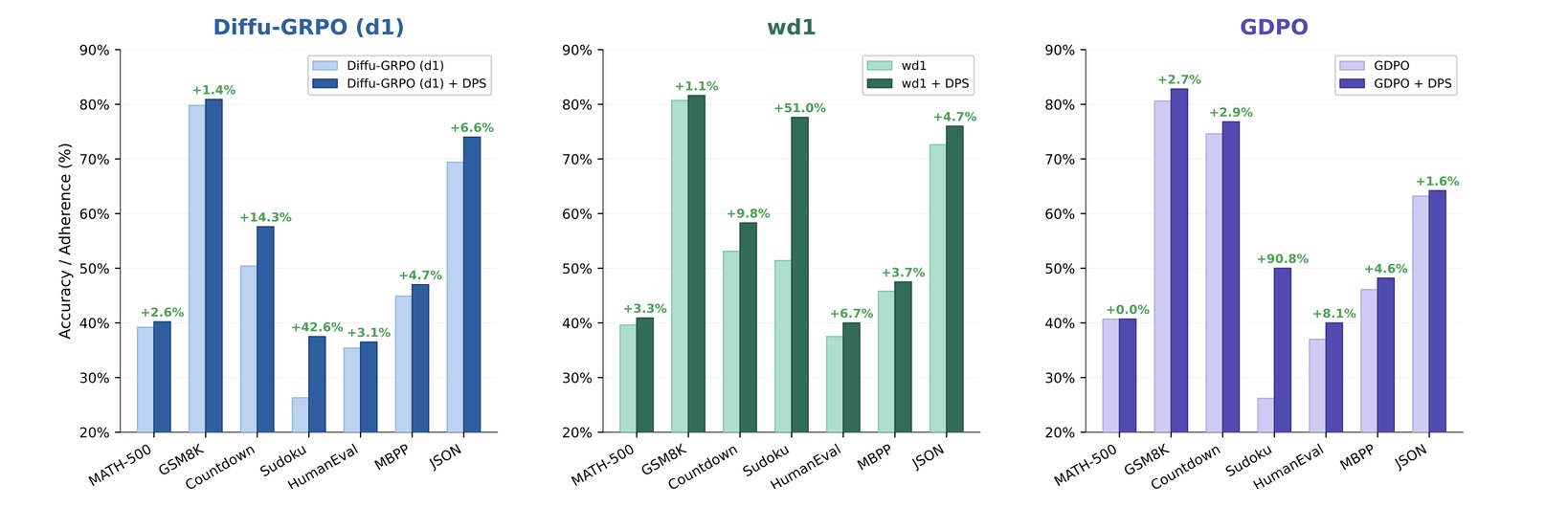
Existing RL methods for diffusion language models treat every denoising step as equally important and rely on biased, high-variance likelihood estimates. DACA-GRPO adds Denoising Progress Scores, which extract per-token importance weights from intermediate predictions at no extra forward cost, and Stratified Masking Likelihood, which reduces mean-field bias. Applied on top of three GRPO base methods, it improves results across seven benchmarks spanning mathematical reasoning, code generation, constraint satisfaction and constrained generation.
arXiv, 2026
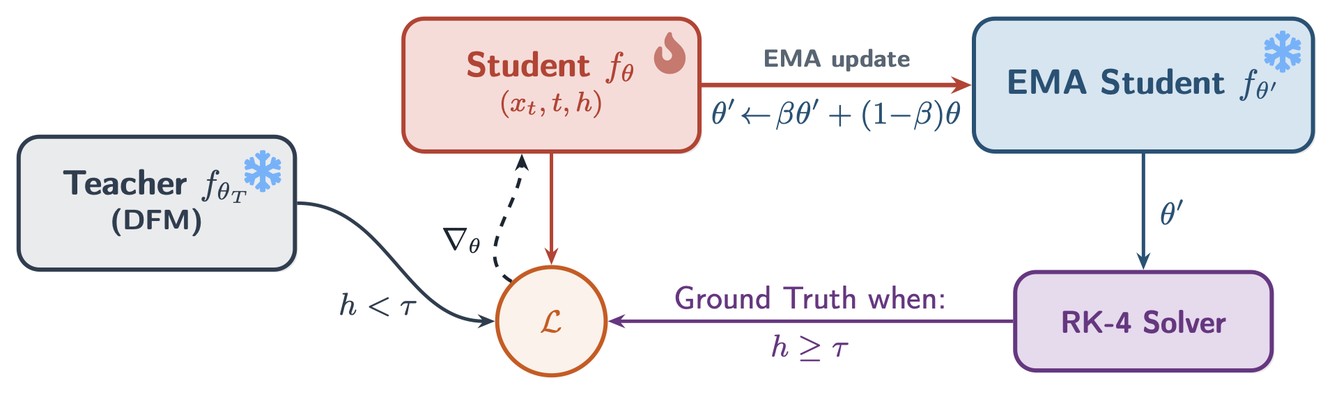
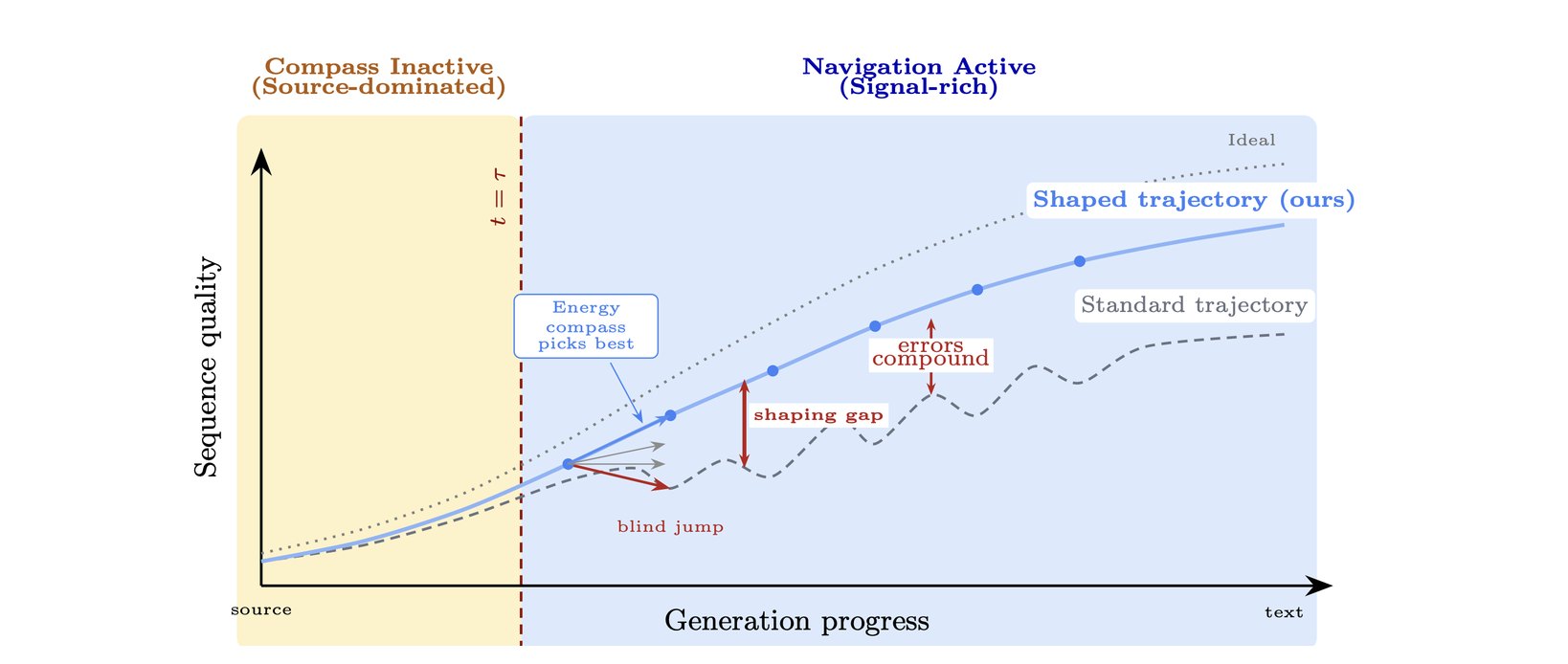
When a distilled few-step student underperforms, the usual explanation is insufficient capacity. This work argues the opposite: the trajectory is the bottleneck, not the student. TS-DFM replaces the blind stochastic jumps of standard trajectory construction with guided navigation, using a lightweight energy compass to evaluate candidate continuations at each midpoint. At 170M parameters the 8-step student reaches 32% lower perplexity than its 1024-step teacher while being 128x faster, with no change to inference cost.
arXiv, 2026
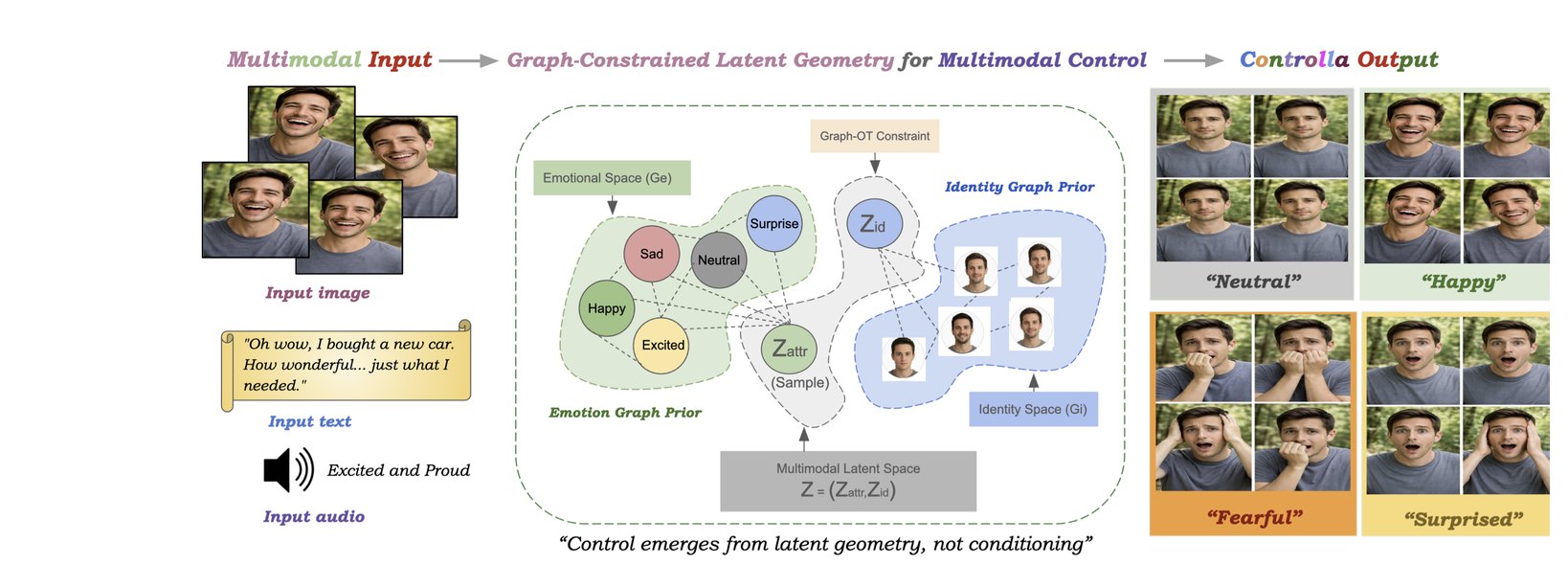
Controllable multimodal generation is usually posed as inference-time conditioning, which leaves unstructured how semantic attributes evolve and invites identity drift. Controlla instead treats controllability as a property of latent geometry: it learns identity and attribute factors from multimodal inputs and aligns them with graph priors through graph-constrained optimal transport, so attributes follow graph-consistent trajectories while reference identity is preserved. The paper also contributes AffectHuman-43K, a leakage-aware multimodal benchmark.
arXiv, 2026
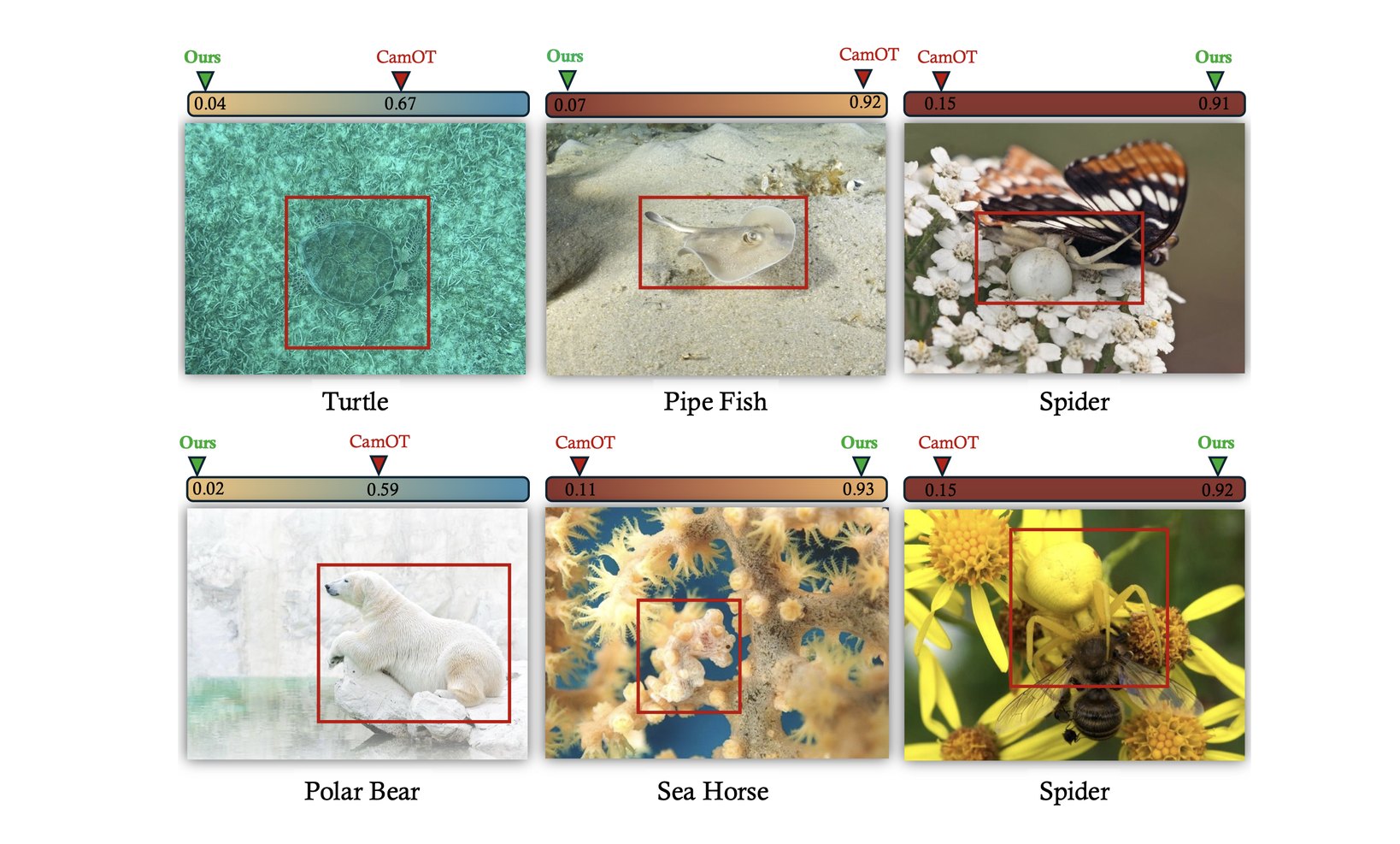
Animals are called well camouflaged when they blend seamlessly into their surroundings, yet no standardised quantitative measure of that seamlessness exists. SeamCam frames camouflage evaluation as visual localisation: a well-camouflaged animal stays hard to detect even when its category is known. In a two-alternative forced-choice study with 94 participants and 2,390 comparisons it agrees with human camouflage judgments 78.82% of the time, roughly 25 points above the state of the art, and doubles as a preference signal for fine-tuning camouflage generation.
arXiv, 2026
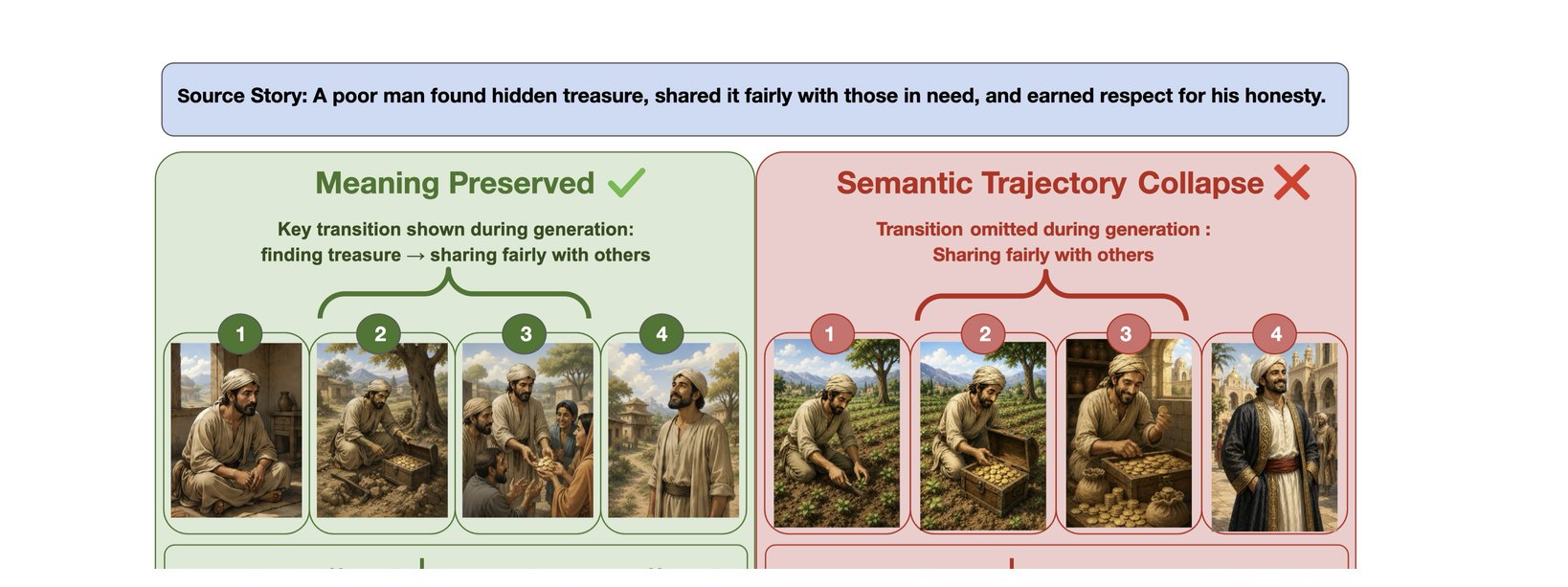
Recent story generators produce visually coherent image sequences, but coherence does not guarantee that the transition meaning of the source story survives. KathaTrace is a generator-agnostic protocol for diagnosing semantic trajectory collapse, evaluating each transition under text-only, image-only and text-plus-image evidence. It contributes KathaBench-25K and defines the Semantic Trajectory Gap, the transition meaning lost during visualisation.
Undergraduate course, Shahid Beheshti University, Department of Computer Science and Engineering, 2013
Teaching assistant for three semesters — spring 2012, fall 2012, and spring 2013.
Undergraduate course, Shahid Beheshti University, Department of Computer Science and Engineering, 2014
Teaching assistant for five semesters — spring 2013, fall 2013, spring 2014, spring 2017, and spring 2018.
Undergraduate course, Shahid Beheshti University, Department of Computer Science and Engineering, 2015
Teaching assistant for two semesters — spring 2015 and fall 2015.
Undergraduate course, Shahid Beheshti University, Department of Computer Science and Engineering, 2016
Teaching assistant for two semesters — fall 2015 and fall 2016.
Undergraduate course, Shahid Beheshti University, Department of Computer Science and Engineering, 2016
Teaching assistant for two semesters — fall 2015 and fall 2016.
Graduate course, Ohio State University, Department of Computer Science and Engineering, 2025
Teaching assistant, spring 2025 — instructor: Dr. Wei-Lun (Harry) Chao.
Undergraduate course, Ohio State University, Department of Computer Science and Engineering, 2025
Teaching assistant for five semesters — fall 2022, spring 2023, fall 2023, spring 2024, and fall 2025.
Undergraduate course, Ohio State University, Department of Computer Science and Engineering, 2026
Teaching assistant for two semesters — spring 2025 (instructor: Ali Alilooee) and fall 2026 (instructor: Mike Green).